The “F” Factor
Women: Where It’s At
By Erin Torneo
 |
|
Escuela by Hannah Weyer |
This is the first and last “Women In Film” article filmmaker Julie
Talen wants to be in. She’d rather talk about multi-channel film
narratives, a form she studied in-depth before using it to tell the
story of a family’s fracturing in her recent debut feature Pretend.
And you can see why. In the film, she pushes the form far beyond
what filmmaker Mike Figgis attempted in Time Code, creating a
visual symphony of multiple frames sliding back and forth, triptychs
offering different simultaneous points of view, and audio channels
overlapping—none of which has anything to do with her being a woman
and everything to do with our “more, more” multi-windowed world and
the possibilities of the digital medium.
After all, it’s been thirty years since the tumultuous gender
politicking of the late 1960s and 1970s, and no one is naïve enough
to expect that there’d be gender parity in the movie industry when
it doesn’t yet exist anywhere else. But how far have women come in
film? In a New York Times article earlier this year, Elvis Mitchell
suggested that while unfortunate to have to point out, 2003 was a
good year for women in film, because of such notable films as
Lost in Translation, Monster, Something’s Gotta Give,
Thirteen, Whale Rider, and the co-directed American
Splendor. Let’s reconsider that: A strong year—for women—because
five and a half films out of how many hundreds of studio, specialty,
doc, and foreign films released were directed by women?
And that’s exactly Talen’s point. “The assumption is that women are
a strange subset and that the real people who are doing it are
male,” she explains. Call it the “F” factor, but a lot of women in
the biz don’t want to identify themselves as “female filmmakers” for
fear of being called a feminist (industry translation: “man-hater”).
“I understand that in some way [the characterization as female
filmmaker] takes away from their accomplishment as filmmakers,” says
Women Make Movies’ Executive Director Debra Zimmerman. “But it’s
affirmative action in a way.”
So what’s the view from the trenches? There are certainly plenty of
women out there making films independently. How does the “F” word
affect them? “I don’t want to be exoticized because of my ethnicity
or because I’m a woman,” says Annemarie Jacir, director of the 2003
award winning short Like Twenty Impossibles. “It’s a
dangerous zone because you don’t have the same opportunities, but I
don’t want to be given opportunity because ‘Oh, you’re a Palestinian
and a female director, and we don’t have enough of that, so here’s
your role. We support you not because of the work you’re doing, but
because of where you come from.’” Zimmerman acknowledges that this
kind of boxing in is a huge problem, as with Sundance ’91 alum Julie
Dash, who became the first African American woman to have a general
theatrical release with Daughter of the Dust, and since then,
says Zimmerman, “she’s had every kind of ‘girls in the hood’
screenplay sent to her.”
Does being called a female filmmaker, or an African American female
filmmaker, or being part of a “Women in Film” issue ghettoize the
women who are making films? Not according to Zimmerman, who still
sees a need to highlight female filmmakers in an effort to counter
their gross under-representation in the marketplace and at
festivals. She points out that in the last three years, for example,
the New York Film Festival included just two films by women per the
twenty-five programmed each year, or fewer than ten percent.
Sundance, on the other hand, offers more hopeful numbers, which
Zimmerman attributes in part to programmers Shari Frilot and
Caroline Libresco. This past January, she notes, if films
co-directed by men were included, women filmmakers accounted for
fifty percent of the competition films at Sundance, but in the
features women directed just two out of twenty-two, with dismal
figures from world cinema and world documentaries. At Toronto last
year, in the main section excluding Canadian films, just
two-and-a-half percent of the features were by women, while in
documentary that statistic rose to twenty-five percent.
 |
|
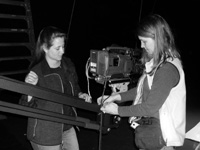
Holly Taylor, DP (left) on the set of Sherman Alexie's The
Business of Fancydancing. |
Likewise, Holly Taylor, a Seattle-based cinematographer who shot
Sherman Alexie’s The Business of Fancydancing and is in
development on Alexie’s forthcoming What You Pawn I Shall Redeem,
explains that as long as the facts are facts—such as the Academy of
Arts and Sciences having yet to recognize a female director or
cinematographer—sexism is alive and well. “It seems like things have
changed because everyone uses politically correct language, but in
fact, I don’t think it’s changed much at all,” Taylor says.
It is important to note, though, that women have historically had a
much easier time assimilating the low cost, less commercial realm of
documentary film. For Melissa Lohman (Grandpa’s Apartment)
and Kelly Duane (See How They Run and Monumental—premiering
this month at the Smithsonian), two documentarians very early in
their career, being female has never been an issue. Their struggles
are simply those of anyone trying to make documentary films—“less a
gender dilemma,” as Lohman puts it, “so much as an artist’s
dilemma.” She and Duane, along with Jacir, have never felt that
being female should be primary to their work. Their projects are
developed without any sense of obligation to tell “women’s stories.”
Interestingly, though, Jacir mentions that someone once questioned
her about why she wrote stories with male protagonists. She
explains: “Because of the way things are, when I write a female
character, the fact that she’s a woman becomes the point of the
story. And I just want to write the story.”
As Gini Reticker’s and Lesli Klainberg’s documentary In the
Company of Women (airing this month on IFC) charts, it was the
first wave of women making films in the 1970s and 80s who really
considered themselves female filmmakers. They mostly showed stories
about women’s lives, in part because they had never really been seen
before. And their work opened up the floor to future generations
like Jacir, Lohman, and Duane, as well as Kim Peirce, Lisa
Cholodenko, and Nicole Holofcener, who no longer feel they have to
make films about women, much less identify themselves as female
filmmakers.
Ironically, such progress has backfired somewhat in that it prevents
some women from being eligible for funds available to female
filmmakers if their work is not about women or from a particularly
female point of view. While Women Make Movies is the largest
distributor of film and videos by and about women, Zimmerman is
quick to point out that their production assistance program is open
to all women, irrespective of the type of films they are
making—their distribution criteria, she says, are both “a political
act as well as smart marketing strategy.” For thirty years, the
non-profit organization has fought for getting forgotten women’s
stories out there, and in doing so has established a successful
niche for itself. But as Zimmerman puts it, “our biggest success
would be if organizations like WMM went out of business because we
were no longer needed.”
But whether or not women filmmakers identify themselves along gender
lines, motherhood, if they choose it, is an irrefutable gender
impasse. “My generation really thought that you’d get married at
twenty-eight, and at twenty-nine you could have a baby strapped to
your back calling ‘Action!’” laughs Talen. The physical realities of
childrearing, of course, are much more limiting. “I was dealing with
a huge shift in my identity, the very real physical
demands—sleepless nights, breastfeeding, ‘wearing of the baby,’ and
of course, falling in love with my child,” recalls Hannah Weyer,
whose daughter was born while she was in post-production on La
Escuela, the second of her two acclaimed documentaries about the
migrant Luis family.
Likewise, both Klainberg and Reticker are moms, with Klainberg
expecting her second child this June. “I’ve never been scared to
talk about [having children], never scared I would lose a job,” she
says. “Actually, having a child is an incredible time-management
tool. I mean, if you thought you were organized before . . . ” In
their film, In the Company of Women, many filmmakers,
including Jodie Foster, talk about motherhood being a valuable
contribution to the work they do. But like any working women, those
in film must grapple with how to find a balance between professional
ambitions and personal family desires. Reticker, however, feels that
film may actually be more forgiving than other industries because it
allows you to go in and out on a project basis.
For Reticker then, motherhood isn’t the barrier. “Our biggest
barrier is getting funding for the kinds of stories we want to
make.” Klainberg agrees, suggesting that the barriers are set up
around executives’ perceptions of the audience—what it wants to
see—and who the so-called audience for “women’s films” is. Part of
Zimmerman’s advocacy is to dismantle these myths about the audience,
particularly in the export/ancillary markets like Asia, which have
become so crucial to a film’s viability. “The top four grossing
pictures in the Philippines were by women,” she argues. “Women went
out in droves to see these films.”
But there’s also a lot of myth about what “women’s films” are. You
wouldn’t call Tanya Steele’s screenplay The Parachute Factory,
which won the IFP Emerging Narratives Award last year and placed
second at Slamdance, a chick flick. For one, it’s an indictment of
violence—a story exploring how the Civil Rights movement was
relevant to victims of domestic violence. “It deals in a lot of
traumas and horrors that I think liberal folks might think they
can’t take on in black characters because it might be too scary,”
she says. But is her brand of violence somehow different because a
woman writes it? “I don’t know. But I do know that the violence is
rattling to some people because it isn’t gratuitous. It’s almost
justified, so they can’t dismiss it.”
Similarly, the onscreen sexuality through the eyes of women can make
men uncomfortable or even frightened, says Zimmerman. She cites
Toronto 2003 films like Jane Campion’s In the Cut, Sue
Brooks’ Japanese Story, Isabel Coixet’s Life Without Me,
and 2001’s Baise-Moi. “They are all in some way about women
being in control of their sexuality, or representing the way women
explore their sexuality, in a way that I think men are actually
afraid of.” In our visual culture, of course, this is because
women’s sexuality has traditionally been controlled through
objectification. So what do women want to see as an audience?
Reticker points to Frances McDormand’s character in Laurel Canyon,
directed by Lisa Cholodenko: “To see a woman just own her sexuality,
and she’s not necessarily good or bad. One of the things Lisa says
about it is that she wasn’t worried about portraying a good or bad
woman, just an interesting one. And that feels like a real
evolution.”
There’s no denying that the issue isn’t a lack of women making good
films. Just look at Sundance, long a measure of the state of
American filmmaking: In 2002, Rebecca Miller’s Personal Velocity
took home both the grand jury award as well as the cinematography
award for Ellen Kuras’ work; in documentary, Lourdes Portillo’s
Senorita Extraviada took a special jury prize, and Gail Dolgin
and Vicente Franco won the grand jury prize for Daughter from
Danang. Last year, Shari Springer Berman and Robert Pulcini’s
American Splendor took the dramatic grand jury prize, while the
directing award went to Katherine Hardwicke for thirteen, and Niki
Caro’s Whale Rider received the audience award in world
cinema.
But for all the attention women filmmakers may get at the rarefied
atmosphere in Park City, in the larger world, there’s still a ways
to go. Not only by rewriting the way women are viewed on screen, but
also in being free from the myths about the kind of movies women
make. What it means to be a female filmmaker, then, is less about
meeting a quota or leveling the playing field. Says Reticker: “It’s
not that women want equal footing with men so much as they want
their stories equally valued in the marketplace.”
 i_independent